Evidence 101
Win your court case through proper evidence.
Evidence 101 exists to teach ordinary people how to collect, preserve, organize, and present evidence to real courtroom standards – so they can win their court cases through credible, verifiable proof that withstands scrutiny.
Because facts only matter if you can prove them.
Evidence wins cases. We teach how.
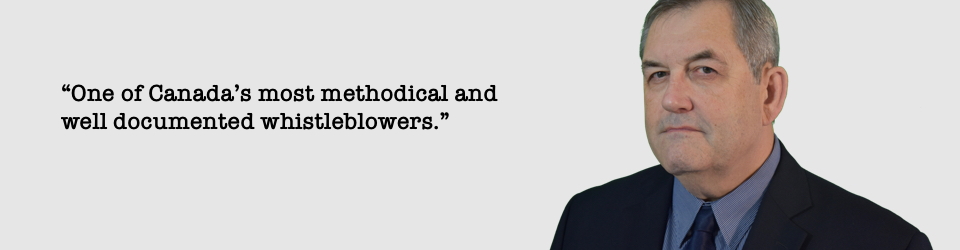
I’ve been working with evidence for a solid 50 years, first as a police detective and later in private practice, where major law firms retained me for litigation support and complex case management. During that time much has changed.
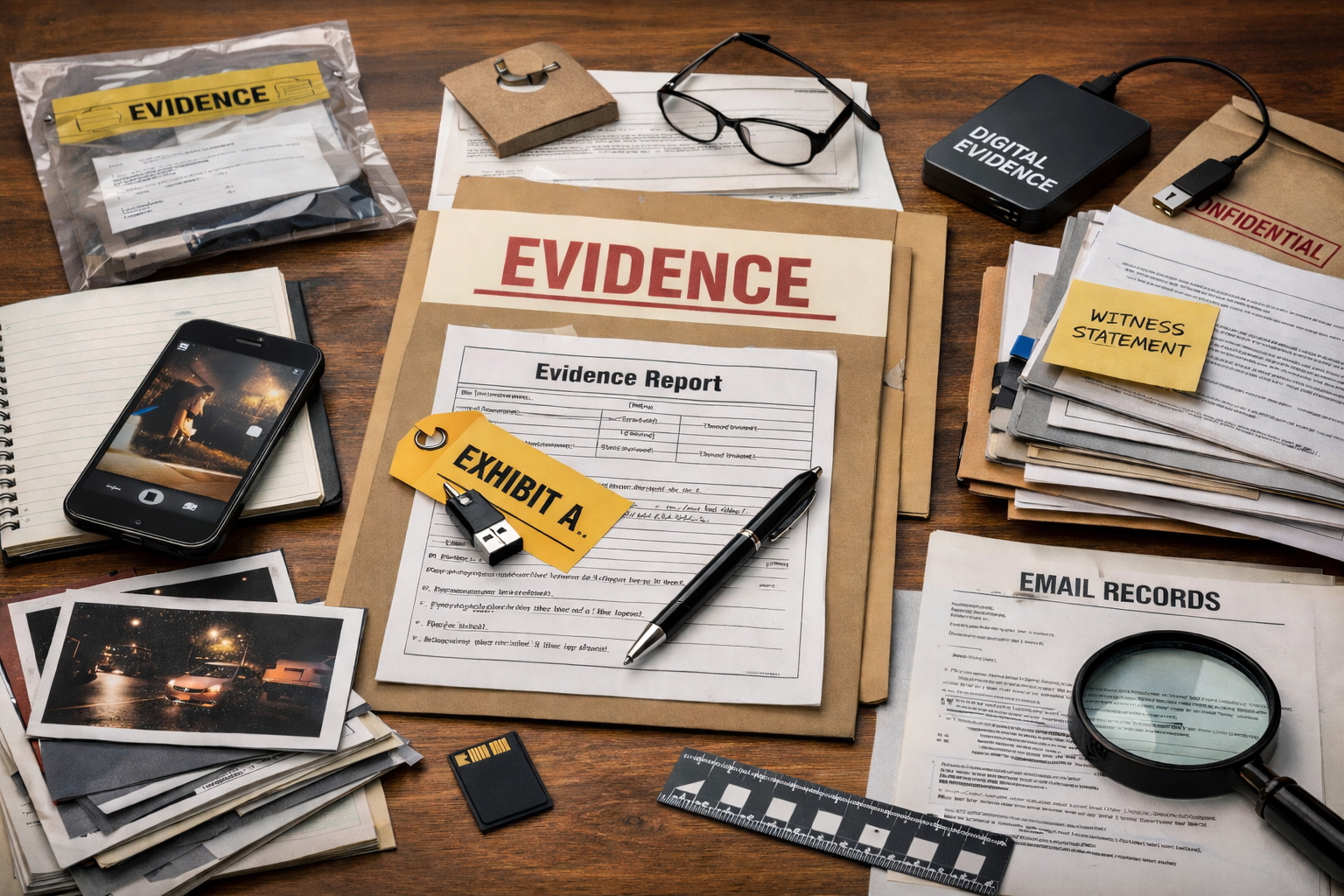
The advent of digital evidence, video cameras everywhere, and the widespread use of emails and chat programs means that almost any case today, criminal or civil, potentially involves hundreds or even thousands of pieces of evidence instead of a handful of documents and photographs as was the standard prior to about 1995.
Today, managing evidence even in smaller cases has become daunting. Basic civil litigation often involves hundreds or even thousands of emails, chats, photos, videos, and other online documents.
Some of the major civil cases I’ve handled had hundreds of thousands of individual exhibits and well over a million individual pages of evidence – each one capable of telling a small or large part of the story for the court.
According to Chief of Police magazine, in 1984 I was the first police officer to bring a portable computer to a crime scene to log evidence. There were no scanners or barcodes. Every exhibit number was typed by hand. In 1982, I won an award for my fraud investigations: never imagining that, fifteen years later, I would be travelling the world (sometimes undercover) to investigate frauds where the losses were counted in hundreds of millions of dollars and more.
Since then my systems have developed: implementing unique Bates numbers on each page of each scanned document, automatic databasing and indexing of exhibits, and in the last year the development of AI-assisted processes capable of automatically reading, analyzing, and databasing tens of thousands of pages of scanned documents in a day.
I used to employ twenty high-level legal clerks for months to do what my single assistant and I can now do in a few days.
But all that aside – the basics of effective evidence gathering, preservation, and presentation haven’t changed.
Whether evidence is handwritten or digital, a photograph or a video, a letter, email or a text message, the same core questions still determine whether it will help you – or harm you – in court:
- Where did it come from?
- Can it be authenticated?
- Has it been preserved properly?
- Can it be trusted?
- Can it be clearly explained to a judge or tribunal?
- Is it relevant to the legal issues at hand?
Evidence 101 is about teaching you to confidently answer those questions – methodically, practically, and in plain language – so your evidence survives scrutiny and actually advances your case.
What Evidence 101 Will Cover
Evidence 101 will guide you through foundational topics, including:
- What courts actually consider to be evidence
- How to identify relevant evidence and avoid costly distractions
- Properly collecting online documents, video and social media evidence
- Preserving digital evidence so it cannot be challenged or dismissed
- Proving source, authenticity, and continuity (the provenance of the evidence)
- Organizing your case exhibits – whether a few or thousands – using simple tools including unique Bates numbers, optical character recognition, and basic databases
- Documenting context so evidence is understood correctly
- Discovering ‘missing’ evidence that fills in gaps in proving your case.
- Avoiding common mistakes that cause evidence to be excluded
- Presenting evidence clearly, logically, and persuasively
- Preparing evidence so your lawyer or the court can actually use it
A Word to the Reader
If you are involved in a court case right now, you may feel overwhelmed. That is normal.
Whether, criminal, civil, or family law, modern cases generate enormous volumes of information. Most people are never taught how to manage evidence properly – especially when it involves large numbers of documents, emails, images, videos, and online records.
You may be surprised to learn that many lawyers – even those with years or decades of experience – have never been trained to systematically collect, organize, or analyze large volumes of evidence. In practice, many rely heavily on clerks, junior associates, or outside services to do this work. Some simply lack the tools or processes to handle it effectively at all.
In such circumstances an ordinary person, even self-represented – if trained and prepared can sometimes run circles around lawyers, or at least hold their own.
By the time you complete Evidence 101, you will not be a master of evidence – but you don’t need to be. You will understand what needs to be proven, how evidence should be collected and preserved, how to document it properly, and how to organize it so it can actually be used to advance your case.
You will know how to work with your evidence confidently – whether you are representing yourself or working alongside a lawyer – instead of being buried by it.
Because nobody knows the evidence of your case like you do.